
Stop Rote Learning: 5 Ways That Build Critical Thinking Skills
October 15, 2025 2026-02-03 16:32Stop Rote Learning: 5 Ways That Build Critical Thinking Skills

The era of simply memorizing facts for a test is over. In today’s rapidly evolving world, employers aren’t looking for human calculators; they are looking for thinkers, innovators, and problem-solvers. The real value of education lies not in what a student can regurgitate but in what they can create, analyze, and apply.
If you’re researching the best school in Indore for your child, or looking through a list of ICSE schools in Indore, you need to look beyond academic results and ask: “Is this school preparing my child for the future?” The key difference lies in the commitment to moving past rote memorization and actively developing critical thinking skills.
What is Critical Thinking, and Why Does Rote Learning Hinder It?
Critical thinking is the ability to analyze information objectively and make a reasoned judgment. It involves synthesis, evaluation, and application, which are the highest levels of learning.
Rote learning, by contrast, is a passive process. It teaches what to think, but never how to think. It fills a student’s mind with information but leaves them utterly unprepared to face an unfamiliar problem. A student might score 100% on a history test, but without critical thinking, they cannot apply those historical lessons to current societal challenges. This passive approach is the single greatest obstacle to genuine intellectual growth.
How Can We Move Beyond Memorization? 5 Transformational Methods
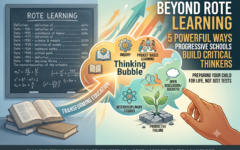
Here are five powerful methods modern, forward-thinking schools use to build genuine critical thinking skills:
1. Project-Based Learning (PBL)
The transition from a passive learning environment to an active one requires a shift in core educational philosophy.
2. Socratic Method and Open-Ended Discussion
Instead of lecturing, teachers pose probing questions that force students to defend their perspectives, consider opposing viewpoints, and justify their reasoning. This practice trains the brain to analyze complex ideas in real-time and articulate sophisticated arguments.
3. Experiential and Inquiry-Based Learning
This approach centers around the student’s natural curiosity. Instead of being told facts, students are given a framework and asked to discover the answer through experimentation, field study, and direct observation. Learning becomes a process of problem-solving, making the knowledge immediately applicable and deeply memorable.
4. Interdisciplinary Studies
Breaking down the traditional walls between subjects (Math, Science, History) forces students to see how concepts connect. For example, analyzing the mathematics of climate change alongside its historical and social impact fosters holistic critical analysis, a skill essential in the real world.
5. Constructive Failure and Iteration
In a rote learning environment, failure is a final grade. In a modern learning environment, failure is a data point. Students are encouraged to experiment, fail, assess why they failed, and try again. This iterative process builds resilience and requires constant self-reflection and analysis—the heart of critical thinking.
Why Is This Model Essential When Choosing the Best Education?
Your choice of school directly impacts your child’s future readiness. When looking at the best ICSE schools in Indore, or researching the top 10 ICSE schools in Indore, inquire specifically about their curriculum philosophy. Does it prioritize breadth of content (rote) or depth of understanding (critical thinking)?
A school dedicated to developing these higher-order critical thinking skills is not just preparing students for college; it is preparing them for life. These skills translate directly into career success, stronger personal decision-making, and the ability to adapt to an unknown future.
Conclusion: Invest in Thinkers, Not Memorizers
We believe that education should empower students to shape the world, not just inherit it. By moving beyond passive rote memorization and embracing active, inquiry-based methods, we equip every child with the tools necessary to become a lifelong learner and a powerful critical thinker.
Ready to see critical thinking in action?
Learn more about our unique curriculum and how we empower students to become the problem-solvers of tomorrow. Schedule a visit today.
Related Posts