
Beyond Rote: 5 Ways Progressive Schools Build Lifelong Critical Thinkers
August 4, 2026 2026-08-04 8:01Beyond Rote: 5 Ways Progressive Schools Build Lifelong Critical Thinkers
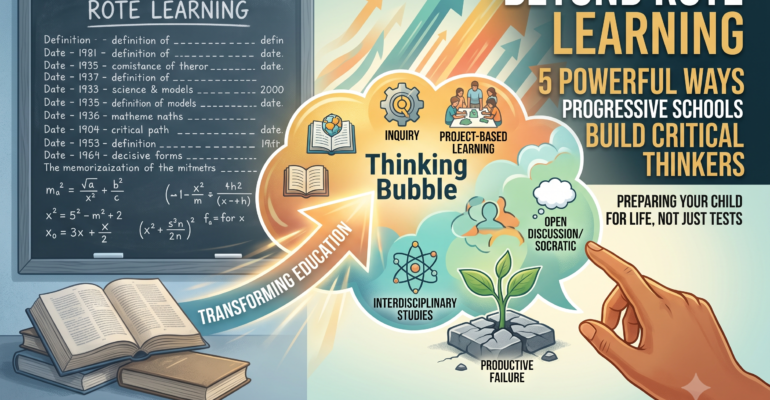
Ask almost any parent what they remember about their own school days, and the answer usually involves endless textbook reading, late-night cramming, and memorizing formulas just long enough to pass an exam. For decades, traditional schooling prioritized speed of recall over depth of understanding. But in today’s rapidly changing world—where information is instantly available at our fingertips—rote learning has lost its value.
Today’s leading educational institutions are shifting focus. If you look at top-ranking institutions across central India, the shift toward progressive, experiential learning is clear. When parents evaluate any comprehensive List of ICSE schools in indore, they increasingly seek environments that teach children how to think, rather than what to think.
Let’s explore how modern progressive pedagogy dismantles rote learning to build independent, lifelong critical thinkers.
What Is Progressive Education and How Does It Challenge Traditional Learning?
Progressive education is a student-centered approach that emphasizes hands-on experience, problem-solving, and real-world application over passive listening and repetitive drills. Traditional models treat students as empty vessels to be filled with facts; progressive education views them as active participants in their own learning journey.
The Council for the Indian School Certificate Examinations (CISCE) curriculum naturally aligns with this philosophy. The official CISCE curriculum overview emphasizes analytical skill development, practical applications, and comprehensive internal assessments over pure reliance on final board examinations.
When searching for the best school in indore, parents often realize that academic excellence isn’t just about test scores—it’s about nurturing curiosity, adaptability, and intellectual independence.
How Do Progressive ICSE Schools Build Critical Thinking Skills? (5 Key Strategies)
Moving away from traditional memorization requires structured pedagogical strategies. Here are the five foundational pillars modern progressive schools use to cultivate sharp, independent analytical minds:
1. Inquiry-Based Learning Over Fact Memorization
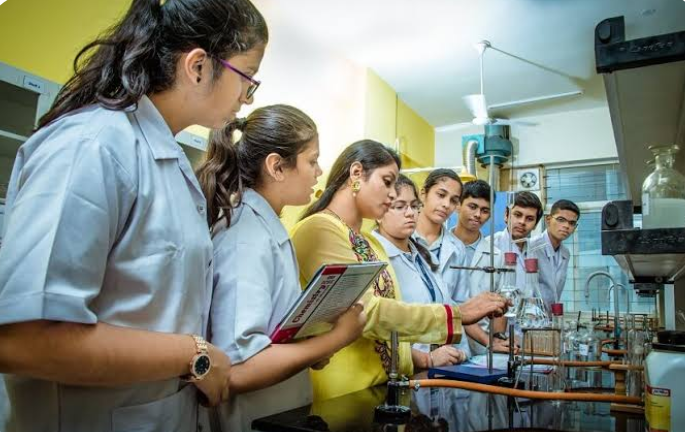
Instead of handing students answers on a whiteboard, teachers present intriguing problems or open questions. Students formulate hypotheses, conduct mini-experiments, gather evidence, and draw their own conclusions. This inquiry mindset turns learning into an engaging investigation rather than a routine chore.
2. Project-Based Learning (PBL) with Real-World Context
In progressive icse schools, learning rarely stays confined to single textbook chapters. Students work on multi-week projects that weave together science, mathematics, ethics, and communication skills. For instance, designing a sustainable waste management plan for a local neighborhood requires research, calculation, creative problem-solving, and public presentation—skills directly applicable to life beyond school.
3. Open Discussions via the Socratic Method
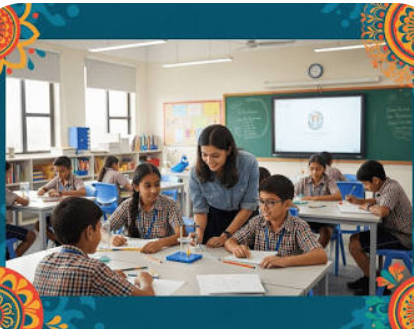
Classrooms in progressive schools feature open dialog rather than one-way lectures. Teachers use targeted, open-ended questioning techniques to encourage students to analyze their assumptions, defend their reasoning, and respectfully challenge alternative viewpoints. This environment builds verbal fluency, confidence, and intellectual humility.
4. Interdisciplinary Subject Integration
Real-world problems don’t arrive neatly labeled as “History” or “Physics.” Progressive education intentionally dissolves subject silos. Studying environmental changes might involve analyzing historical industrial trends, evaluating biological impact data, and writing persuasive essays on conservation policy. This integrated approach trains the brain to recognize complex patterns across disciplines.
5. Embracing “Productive Failure” as a Learning Tool
In conventional classrooms, making a mistake is penalized with lost marks. In progressive environments, error analysis is celebrated as an essential step toward deep understanding. Students test theories, analyze why something failed, refine their approach, and try again. This iterative process builds resilience, adaptability, and true scientific thinking.
Why Is Critical Thinking Essential When Choosing the Best ICSE Schools in Indore?
When parents search for the best school in indore icse, they are planning for their child’s success 15 to 20 years down the line. Future careers in technology, engineering, management, and the creative arts will demand human skills that machines cannot replicate: empathy, strategic problem-solving, original synthesis, and critical judgment.
Schools that lead the Best icse schools in indore listings recognize this shift. By combining the academic depth of the ICSE framework with modern progressive teaching practices, they prepare students not just to top entrance examinations, but to navigate complex global challenges with clarity and confidence.
Conclusion: Investing in the Mind, Not Just the Marksheet
Choosing an educational path for your child is one of the most consequential decisions you will make as a parent. While high test scores remain important, true long-term success stems from a mind trained to analyze, adapt, and innovate.
By choosing a progressive school that actively rejects rote learning in favor of experiential growth, you give your child a gift that lasts a lifetime: the power of critical thought.
Frequently Asked Questions (FAQs)
FAQ 1: How does an ICSE curriculum support critical thinking compared to other boards?
The ICSE (CISCE) curriculum is widely recognized for its detailed, application-oriented syllabus, particularly in English language, humanities, and sciences. Rather than relying strictly on direct textbook questions, ICSE assessments frequently feature application-based and analytical questions that test conceptual understanding rather than simple memory recall.
FAQ 2: Will progressive teaching methods adequately prepare students for competitive exams?
Yes. Competitive examinations (such as JEE, NEET, CUET, and SAT) increasingly test conceptual clarity and speed of analytical reasoning rather than formulaic memorization. Students trained in progressive environments understand the foundational “why” behind scientific and mathematical concepts, giving them a distinct advantage under pressure.
FAQ 3: How can parents tell if a school genuinely practices progressive education or just uses it as a marketing term?
Look beyond classroom infrastructure. Ask school administrators about their teaching methodologies: Do students spend most of their time listening to lectures, or are they working on group projects and hands-on experiments? Look at homework assignments—are they asking children to copy answers from books, or to research, construct arguments, and solve novel problems?
FAQ 4: How can I find the best school in Indore ICSE for my child’s specific personality?
Start by reviewing the official List of ICSE schools in indore, shortlist institutions known for holistic development, and schedule campus visits. Pay close attention to teacher-student interaction, classroom setup, laboratory facilities, and how the school balances academic rigor with co-curricular growth
Related Posts