
5 Red Flags Your Traditional School is Teaching ‘Rote’ Skills in a Creative World
April 2, 2026 2026-04-02 8:175 Red Flags Your Traditional School is Teaching ‘Rote’ Skills in a Creative World
We are living in an era defined by rapid change, where creativity and adaptability are the real currencies of success. For decades, the mantra for academic achievement was simple: study hard, memorize the text, and ace the exam. But as we navigate a world where information is a click away and AI is redefining industries, that ancient blueprint is cracked. The hard truth is this: The skills that got us here won’t get our children there.
If you are a parent, your primary concern is preparing your child not just for an exam, but for life. We often assume that “reputation” equals “readiness.” We search for the top icse schools near me, believing a gold standard curriculum from 1990 is still the gold standard in 2026. This assumption might be the biggest mistake we can make for our kids.
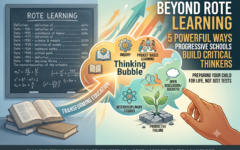
Rote learning—the act of memorizing information through repetition without understanding its underlying meaning—is an industrial-age tool. In a creative world, it’s a red flag. Here are five critical signs that your child’s current traditional school might be stuck in the past, teaching ‘rote’ skills in a world that demands innovation.
1. The Textbook is the Boundary (Not the Launchpad)
The first red flag is a classroom where knowledge has rigid borders. In many traditional environments, the curriculum begins and ends within the pages of a single textbook. If the material isn’t in Chapter 4, it isn’t taught. Progressive education, on the other hand, views textbooks as one of many starting points. Real learning happens when a student uses a concept from the text to ask, “Why?” or “What if?” If your child is rarely challenged to seek information outside the syllabus, they are being trained in consumption, not curiosity.
2. Standardized Testing Defines Success
We have all been trained to believe that the report card is the final verdict on intelligence. In traditional models, success is optimized for the test. Children learn to pass, not to understand. They become experts in predicting what will be on the exam rather than experts in critical thought. When you are searching for the Best icse schools near me, you are often looking at historical test scores, not historical innovation. True, deep understanding cannot always be captured in a multiple-choice bubble.
3. The Classroom Hierarchy is Strict and One-Way
Observe a typical classroom. If the teacher is the sole “fount of knowledge” standing at the front, and the students are passive “empty vessels” waiting to be filled, rote learning is likely thriving. Effective 21st-century education is a dialogue, not a monologue. A major red flag is a school that discourages challenging the teacher’s perspective or asking questions that are “off-topic.” Creativity requires an atmosphere where it is safe to explore, and that means the teacher must sometimes step back and become a co-learner.
4. Rote Memorization is a Daily Habit
Is your child spending hours every night just memorizing dates, formulas, and vocabulary lists, only to forget them the moment the exam is over? This is the clearest symptom of a rote system. While foundational knowledge is essential, true mastery lies in applying that knowledge to new situations. If the primary “homework” is simple regurgitation, they are being taught that facts are more important than thinking. Progressive schools focus on deep concept-level understanding, where the facts are anchors for complex problem-solving.
5. Collaboration is Seen as a Hindrance to Individual Work
In the real world, big problems are solved by diverse teams. In many traditional settings, children are penalized for collaboration; it’s often confused with “copying.” We isolate them during their most formative years, only to drop them into a workforce that demands advanced emotional intelligence and teamwork skills. A school that doesn’t build meaningful collaborative projects into its daily routine is failing to teach the most vital skill of the modern era.
Why Does This Matter in 2026?
The world has changed more in the last five years than in the previous fifty. A traditional education model optimized for conformity and repetition is producing graduates who are easily replaced by automated systems. The Best icse board school in indore in 2026 isn’t the one that is the most strict; it’s the one that is the most agile.
Rote learning doesn’t just limit potential; it also impacts mental health. When children are taught that their only value is their ability to perform standardized tasks perfectly, they develop severe anxiety about making mistakes. Creativity requires making mistakes. A progressive model values resilience, emotional intelligence (SEL), and adaptability as highly as academic scores.
How Progressive Education is the Alternative
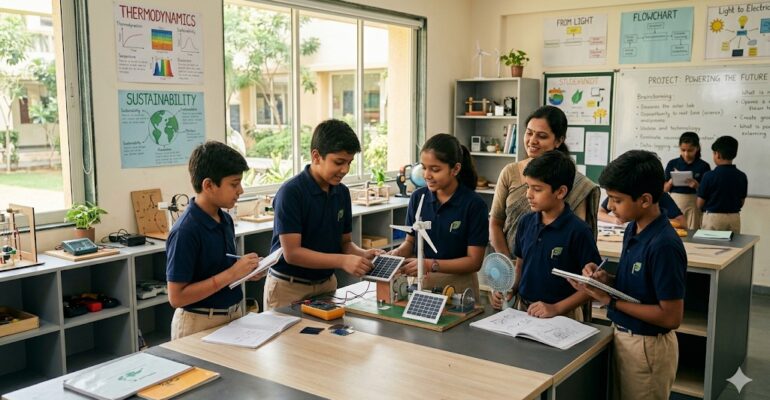
Progressive education flips the traditional model on its head. It focuses on the learner, not the test. Instead of asking “How smart is this child?”, it asks “How is this child smart?”. By prioritizing active, project-based learning (PBL) and fostering inquiry, it moves from “what to think” to “how to think.”
This is why, when you look for Icse schools near me with fees structure, you shouldn’t just look at the bottom line; you must evaluate the return on human capital. A progressive school investment is an investment in your child’s ability to navigate a VUCA (Volatile, Uncertain, Complex, Ambiguous) world.
A Parent’s Perspective: Moving from Rote to Real-World Learning
Many parents in our community have made the switch after realizing their children were “successful but stressed.” Here is a heart-to-heart review from Ananya Sharma, a mother of two, who recently transitioned her son from a standard academic environment to a progressive model.
For years, I followed the herd. I looked for the most prestigious names when searching for the top icse schools near me, thinking that a heavy bag and a 95% score meant my son was ‘winning.’ But by 7th grade, he was a robot. He could recite a history chapter word-for-word, but he couldn’t tell me why those events mattered today.
When I finally looked into the best school in Indore that actually followed a progressive ICSE curriculum, the difference was night and day. In his old traditional school, he was terrified of being ‘wrong.’ In his new progressive environment, ‘wrong’ is just a data point for a better second attempt.
If you are looking at Icse schools near me with fees structure, don’t just look at the building or the brand. Look at the children’s eyes. Are they curious or just compliant? Switching was the best decision we made for his mental health and his future. He isn’t just a student anymore; he’s a thinker.
Tips for Parents Searching for the Right Environment
If you’ve recognized these red flags in your child’s current environment, don’t panic. There are options. Here is a checklist when evaluating alternatives like the best school in Indore:
- Ask for Project Examples: Don’t just look at art projects. Ask to see science or history projects. Are they all identical, or does each student’s project show unique thought and execution?
- Observe a Class: Is it quiet, with every child facing forward? Or is it a buzz of activity with students working in groups and a teacher moving among them?
- Ask About Assessment: Ask how they measure growth beyond standardized tests. Do they use portfolios, self-reflection, or exhibitions of mastery?
- Trust Your Gut: You know your child. If they are bored, disengaged, or stressed by the constant race, the environment is wrong, regardless of its reputation..
Why your choice today shapes their 2040
The best school is not the most famous one. The best school is the one that prepares your child to be the most curious, resilient version of themselves. In a world where technical skills expire every few years, a child’s ability to learn, unlearn, and relearn is their only true superpower.
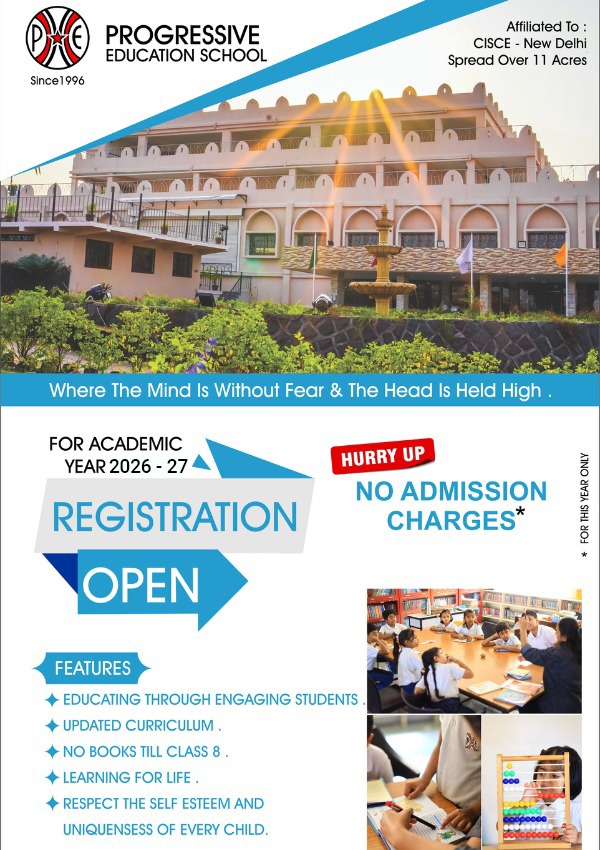
If you are tired of the “rankings race” and want an environment where your child’s individuality is the priority, it’s time to look beyond the brochure. Explore Progressive Education School – East Campus for such innovative methods that bridge the gap between traditional excellence and future-ready skills. We don’t just teach subjects; we ignite minds through hands-on inquiry and collaborative problem-solving.
Take the Next Step
Don’t settle for “good enough” when your child’s future is at stake. While you may be comparing Icse schools near me with fees structure, we invite you to compare the experience.
Visit Us: See our inquiry-based classrooms in action.
Meet the Mentors: Talk to our educators about how we move beyond rote learning.
Discover the Difference: See why we are consistently cited as the best school in Indore for parents who value innovation over imitation.
[Click Here to Schedule a Campus Tour at East Campus]
Frequently Asked Questions (FAQ)
Q1: What is the main difference between rote learning and conceptual learning?
A1: Rote learning focuses on memorizing facts through repetition to pass exams. Conceptual learning focuses on deeply understanding the underlying principles of a subject and applying that knowledge to solve new and unexpected problems.
Q2: Is traditional ICSE education always rote learning?
A2: No. The ICSE curriculum itself is quite broad and deep. However, how a specific school chooses to deliver that curriculum is what matters. Many traditional schools still use rigid, rote-based teaching methods to cover the ICSE syllabus, but a progressive ICSE school will use inquiry and hands-on projects to deliver the same curriculum.
Q3: Will my child still be prepared for competitive exams in a progressive school?
A3: Absolutely. Progressive students often perform better on complex problem-solving because they have a deeper conceptual foundation. They learn to be critical thinkers, which is a massive advantage in modern competitive exams that require analyzing data and applying logic rather than simple recall.
Related Posts